



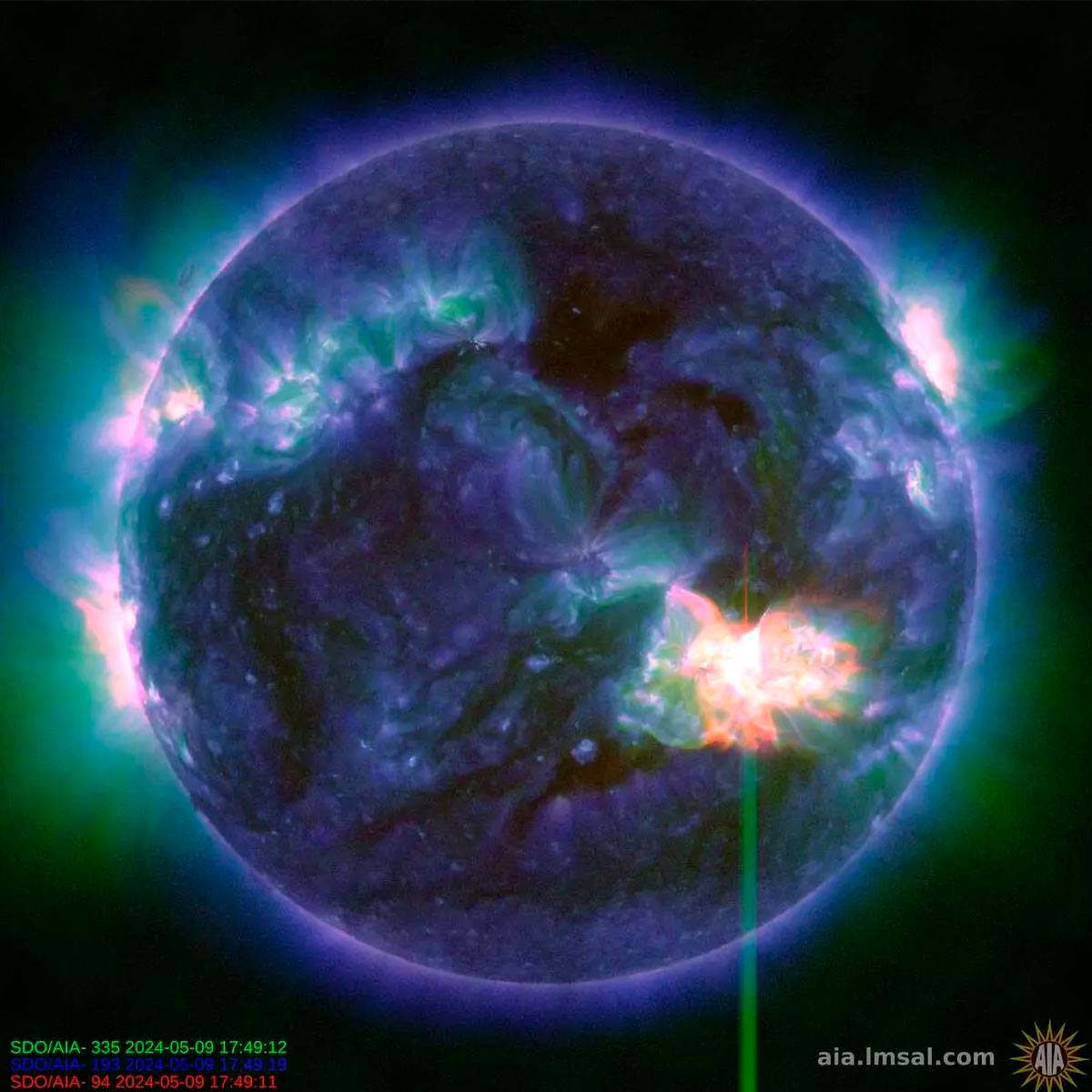
On March 28, 2024, the Sun unleashed a powerful solar flare, peaking at 4:56 p.m. ET, which was captured by NASA’s Solar Dynamics Observatory. This X1.1 flare is a significant event, as it belongs to the most intense category of solar flares, capable of releasing vast amounts of energy equivalent to millions of 100-megaton hydrogen bombs exploding at once.
Solar flares are intense bursts of radiation emanating from the release of magnetic energy in the Sun’s atmosphere. They can affect the Earth in several ways, disrupting satellite operations, communication systems, and even power grids on the ground. The intensity of solar flares is classified based on their brightness in the X-ray wavelengths, ranging from A (weakest) to X (strongest), with each category having a tenfold increase in energy output.
Subheading: Potential Impacts of Solar Flares
Solar flares can have significant impacts on various systems and technologies on Earth. Satellite operations can be disrupted, leading to communication disruptions and navigation problems. Power grids can also be affected, as the geomagnetically induced currents caused by solar flares can overload and damage electrical transformers. Additionally, solar flares can disrupt communication systems, including radio, television, and internet, by interfering with the ionosphere, the layer of the Earth’s atmosphere that reflects radio waves.